• 17. APRIL 2020
    The influence of food intake specificity in children with autism on gut microbiota

    The influence of food intake specificity in children with autism on gut microbiota

    AUTORI: Sashova Tomova, A., Šoltys, K., Keményová, P., Karhánek, M. and Babinská, K. ABSTRACT: Autism spectrum disorder (ASD) is a complex of neurodevelopmental conditions with increasing incidence. The microbiota of children with ASD is distinct from neurotypical children, their food habits are also different, and it is known that nutrient intake influences microbiota in a

    • 20. JANUARY 2020
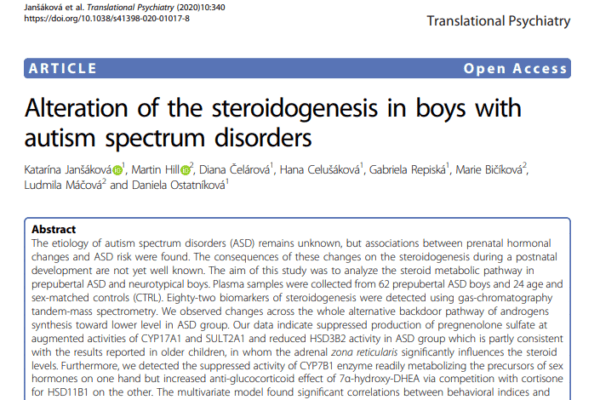
    Alteration of the steroidogenesis in boys with autism spectrum disorders

    Alteration of the steroidogenesis in boys with autism spectrum disorders

    AUTORI: Jansakova, K., Hill, M., Celarova, D., Celusakova, H., Repiska, G., Bicikova, M., Macova, L., Ostatnikova, D.

    ABSTRACT: The etiology of autism spectrum disorders (ASD) remains unknown, but associations between prenatal hormonal changes and ASD risk were found. The consequences of these changes on the steroidogenesis during a postnatal development are not yet well known. The aim of this study was to analyze the steroid metabolic pathway in prepubertal ASD and neurotypical boys. Plasma samples were collected from 62 prepubertal ASD boys and 24 age and sex-matched controls (CTRL). Eighty-two biomarkers of steroidogenesis were detected using gas-chromatography tandem-mass spectrometry. We observed changes across the whole alternative backdoor pathway of androgens synthesis toward lower level in ASD group. Our data indicate suppressed production of pregnenolone sulfate at augmented activities of CYP17A1 and SULT2A1 and reduced HSD3B2 activity in ASD group which is partly consistent with the results reported in older children, in whom the adrenal zona reticularis significantly influences the steroid levels. Furthermore, we detected the suppressed activity of CYP7B1 enzyme readily metabolizing the precursors of sex hormones on one hand but increased anti-glucocorticoid effect of 7α-hydroxy-DHEA via competition with cortisone for HSD11B1 on the other. The multivariate model found significant correlations between behavioral indices and circulating steroids. From dependent variables, the best correlation was found for the social interaction (28.5%). Observed changes give a space for their utilization as biomarkers while reveal the etiopathogenesis of ASD. The aforementioned data indicate a direction of the future research with a focus on the expression and functioning of genes associated with important steroidogenic enzymes in ASD patients from early childhood to adrenarche.

    Translational Psychiatry, 2020, 10: 1-15

    https://www.nature.com/articles/s41398-020-01017-8.pdf?origin=ppub

    • 1. AUGUST 2019
    Plasma levels of glial cell marker S100B in children with autism

    Plasma levels of glial cell marker S100B in children with autism

    AUTORI: Sashova Tomova, A., Kemenyova, P., Celarova, D., Szapuova, Z., Kovac, A., Babinska, K., Ostatnikova D.

    ABSTRACT: Autism spectrum disorder (ASD) is a neurodevelopmental condition with increasing incidence. Recent evidences suggest glial cells involvement in autism pathophysiology. S100B is a calcium binding protein, mainly found in astrocytes and therefore used as a marker of their activity. In our study, children with autism had higher plasma concentrations of S100B compared to non-autistic controls. No association of S100B plasma levels with behavioral symptoms (ADI-R and ADOS-2 scales) was found. Plasma S100B concentration significantly correlated with urine serotonin, suggesting their interconnection. Correlation of plasma S100B levels with stool calprotectin concentrations was found, suggesting not only brain astrocytes, but also enteric glial cells may take part in autism pathogenesis. Based on our findings, S100B seems to have a potential to be used as a biomarker of human neurodevelopmental disorders, but more investigations are needed to clarify its exact role in pathomechanism of autism.

    Physiol Res, 2019. 68(3) Supplementum: 315-323.

    http://www.biomed.cas.cz/physiolres/pdf/68/68_S315.pdf

    • 1. JULY 2019
    Behaviorálne stratégie v terapii psychogénnej straty chuti do jedla v detstve (Behavioral approaches in the therapy of pediatric feeding disorders)

    Behaviorálne stratégie v terapii psychogénnej straty chuti do jedla v detstve (Behavioral approaches in the therapy of pediatric feeding disorders)

    AUTORI: Celarova, D., Babinska, K., Celusakova, H., Ostatnikova, D.

    ABSTRACT: Adequate intake of qualitatively and quantitatively balanced food is essential for healthy psychosomatic development of children and adolescents. At present time, the experts focus mostly on excessive calorie intake, due to high obesity prevalence in children. However, according to current knowledge 3-4% of children suffer from severe food refusal without a known somatic cause, referred to as avoidant/restrictive food intake disorder, or psychogenic loss of appetite. The “wait-and-see” method is currently the most commonly used in the management of this disorder, but the most effective intervention has been shown to be techniques based on behavioral therapy. The aim of our work is to describe the main etiological aspects of the avoidant/restrictive food intake disorder and to introduce methods that are most effective for its treatment. These methods are based primarily on behavioral therapy principles, where our goal is the behavioral change. Knowledge and application of these strategies is important for not only scientific community, but also for clinical professionals and parents.

    Československá psychologie 2019. 63(1): p. 116-126.

    https://kramerius.lib.cas.cz/view/uuid:3db71ce2-5b9a-4a18-b704-655c14576081?article=uuid:dc4dfdb2-e3a4-4c90-818d-42435fe5abe5