• 1. JUNE 2019
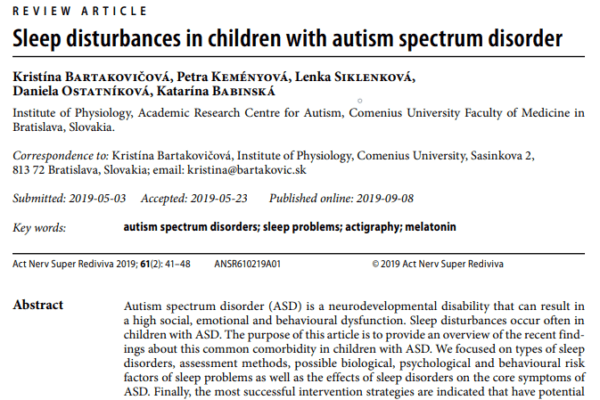
    Sleep disturbances in children with autism spectrum disorder

    Sleep disturbances in children with autism spectrum disorder

    AUTORI: Bartakovičová, K., Keményová, P., Siklenková, L., Ostatníková, D., Babinská, K..

    ABSTRACT: Autism spectrum disorder (ASD) is a neurodevelopmental disability that can result in a high social, emotional and behavioural dysfunction. Sleep disturbances occur often in children with ASD. The purpose of this article is to provide an overview of the recent findings about this common comorbidity in children with ASD. We focused on types of sleep disorders, assessment methods, possible biological, psychological and behavioural risk factors of sleep problems as well as the effects of sleep disorders on the core symptoms of ASD. Finally, the most successful intervention strategies are indicated that have potential to improve the quality of life of children with ASD and their families.

    Activitas Nervosa Superior Rediviva. – Roč. 61, č. 2 (2019), s. 41-48. – ISSN (print) 1337-933X

    http://rediviva.sav.sk/61i2/41.pdf

    • 1. JUNE 2019
    Erythrocyte deformability in children with autism spectrum disorders: correlation with clinical features

    Erythrocyte deformability in children with autism spectrum disorders: correlation with clinical features

    AUTORI: Jasenovec, T., Radosinska, D., Celusakova, H., Celarova, D., Radosinska, J.

    ABSTRACT: Biomechanical properties of erythrocytes play an important role in health and disease. Deformability represents intrinsic property of erythrocytes to undergo deformation that is crucial for their passage through the narrow capillaries. The erythrocyte damage can lead to compromised tissue perfusion and consequently play a role in the pathogenesis of various diseases including neurological ones. Data available in databases indicate that erythrocytes in autism spectrum disorder (ASD) are altered. This may affect the clinical symptoms of ASD. The aim of our study was to determine erythrocyte deformability in 54 children with ASD and correlate it with clinical symptoms. We found significant negative correlation between erythrocyte deformability and score in C domain of the Autism Diagnostic Interview Revised (ADI-R) diagnostic tool describing the measure of restrictive, repetitive, and stereotyped behaviors and interests, mainly observable in C1 and C2, but not in C3 and C4 subdomains. This supports the findings of other authors and suggest that behavioral domain C comprises of more subcategories with different underlying etiology. Our results also indicate that abnormalities in erythrocyte deformability may be involved in ASD pathomechanisms and contribute to its clinical manifestation. Further research is necessary to bring more data and identify erythrocyte deformability as prognostic biomarker in ASD.

    Physiol Res, 2019. 68(3) Supplementum: 307-313.

    http://www.biomed.cas.cz/physiolres/pdf/68/68_S307.pdf

    • 1. JUNE 2018
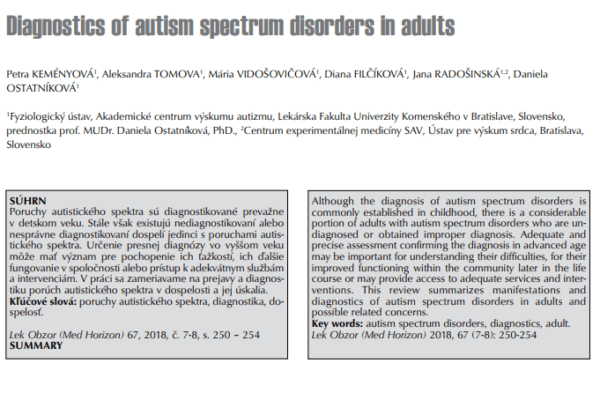
    Diagnostika porúch autistického spektra v dospelosti (Diagnostics of autism spectrum disorders in adults)

    Diagnostika porúch autistického spektra v dospelosti (Diagnostics of autism spectrum disorders in adults)

    AUTORI: Keményová, P., Sashova Tomova, A., Vidošovičová, M., Čelárová, D., Radošinská, J., Ostatníková, D.

    ABSTRACT: Although the diagnosis of autism spectrum disorders is commonly established in childhood, there is a considerable portion of adults with autism spectrum disorders who are undiagnosed or obtained improper diagnosis. Adequate and precise assessment confirming the diagnosis in advanced age may be important for understanding their difficulties, for their improved functioning within the community later in the life course or may provide access to adequate services and interventions. This review summarizes manifestations and diagnostics of autism spectrum disorders in adults and possible related concerns.

    Lekársky obzor. – Roč. 67, č. 7-8 (2018), s. 250-254. – ISSN (print) 0457-4214

    Lekársky obzor – HERBA – Lekársky obzor 7-8/2018

    • 1. JUNE 2018
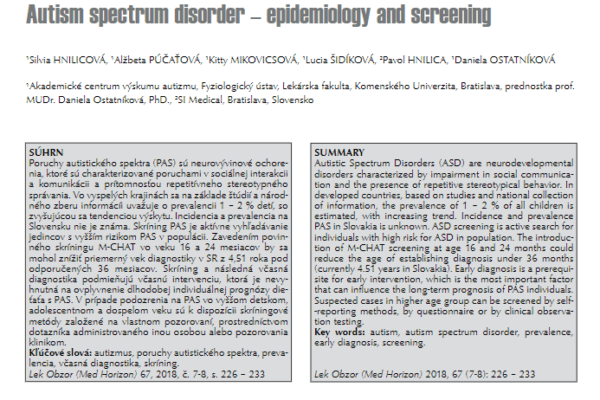
    Poruchy autistického spektra – epidemiológia a skríning (Autism spectrum disorder – epidemiology and screening)

    Poruchy autistického spektra – epidemiológia a skríning (Autism spectrum disorder – epidemiology and screening)

    AUTORI: Hnilicová, S., Púčaťová, A., Mikovicsová, K., Šidíková, L., Hnilica, P., Ostatníková, D.

    ABSTRACT: Autistic Spectrum Disorders (ASD) are neurodevelopmental disorders characterized by impairment in social communication and the presence of repetitive stereotypical behavior. In developed countries, based on studies and national collection of information, the prevalence of 1 – 2 % of all children is estimated, with increasing trend. Incidence and prevalence ASD in Slovakia is unknown. ASD screening is active search for individuals with high risk for ASD in population. The introduction of M-CHAT screening at age 16 and 24 months could reduce the age of establishing diagnosis under 36 months (currently 4.51 years in Slovakia). Early diagnosis is a prerequisite for early intervention, which is the most important factor that can influence the long-term prognosis of PAS individuals. Suspected cases in higher age group can be screened by self-reporting methods, by questionnaire or by clinical observation testing.

    Lekársky obzor. – Roč. 67, č. 7-8 (2018), s. 226-233. – ISSN (print) 0457-4214

    Lekársky obzor – HERBA – Lekársky obzor 7-8/2018