
• 1. JUNE 2018
    Na dôkazoch založené intervencie pre ľudí s poruchou autistického spektra (Evidence-based interventions for individuals with autism spectrum disorders)

    Na dôkazoch založené intervencie pre ľudí s poruchou autistického spektra (Evidence-based interventions for individuals with autism spectrum disorders)

    AUTORI: Čelárová, D., Celušáková, H., Trellová, I., Szapuová, Ž., Ostatníková, D.

    ABSTRACT: Autism spectrum disorders are a group of neurodevelopmental disorders that manifest in early childhood and persist throughout the lifespan. Core symptoms include social communication deficits and the presence of stereotyped and repetitive behaviors. Despite intensive research, the etiology still remains unknown, and no medications are approved for the treatment of core symptoms of autism. Evidence-based interventions are based on the principles of applied behavioral analysis, and has been shown to be effective particularly when used in early childhod. Parents of children with autism spectrum disorder, however, often invest their finance and time into interventions that are not only ineffective, but can also pose a threat to the healthy development of the child. The role of professionals should therefore be to help parents to be able to decide for the most effective treatment for their child and by that increase the quality of life for the whole family.

    Lekársky obzor. – Roč. 67, č. 7-8 (2018), s. 255-259. – ISSN (print) 0457-4214
    Lekársky obzor – HERBA – Lekársky obzor 7-8/2018

    • 1. JUNE 2018
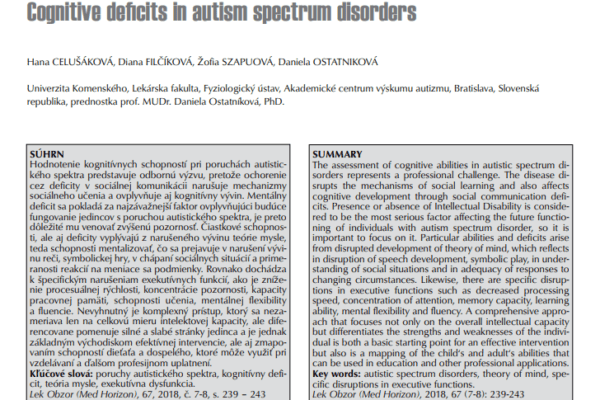
    Kognitívne deficity pri poruchách autistického spektra (Cognitive deficits in autism spectrum disorders)

    Kognitívne deficity pri poruchách autistického spektra (Cognitive deficits in autism spectrum disorders)

    AUTORI: Celušáková, H., Čelárová, D., Szapuová, Ž., Ostatníková, D.

    ABSTRACT: The assessment of cognitive abilities in autistic spectrum disorders represents a professional challenge. The disease disrupts the mechanisms of social learning and also affects cognitive development through social communication deficits. Presence or absence of Intellectual Disability is considered to be the most serious factor affecting the future functioning of individuals with autism spectrum disorder, so it is important to focus on it. Particular abilities and deficits arise from disrupted development of theory of mind, which reflects in disruption of speech development, symbolic play, in understanding of social situations and in adequacy of responses to changing circumstances. Likewise, there are specific disruptions in executive functions such as decreased processing speed, concentration of attention, memory capacity, learning ability, mental flexibility and fluency. A comprehensive approach that focuses not only on the overall intellectual capacity but differentiates the strengths and weaknesses of the individual is both a basic starting point for an effective intervention but also is a mapping of the child‘s and adult‘s abilities that can be used in education and other professional applications.

    Lekársky obzor. – Roč. 67, č. 7-8 (2018), s. 239-243. – ISSN (print) 0457-4214

    Lekársky obzor – HERBA – Lekársky obzor 7-8/2018

    • 1. JUNE 2018
    Nutričné a gastrointestinálne problémy pri poruchách autistického spektra a ich riešenie (Gastrointestinal and nutritional problems in autism spectrum disorders and their treatment)

    Nutričné a gastrointestinálne problémy pri poruchách autistického spektra a ich riešenie (Gastrointestinal and nutritional problems in autism spectrum disorders and their treatment)

    AUTORI: Babinská, K., Filčíková, D., Nemcsicsová, D., Ostatníková, D.

    ABSTRACT: Except the core symptoms including impaired social interaction, deficits in communication and stereotyped behaviour, children with autism spectrum disorders (ASD) may present also symptoms of numerous comorbid conditions. In ASD increased prevalence of functional and inflammatory disorders of gastrointestinal (GI) system are present, also food allergies and intolerances, often with atypical manifestation in form of challenging behaviour. Differences in gut microbiota seem to play role, in addition, altered signalling from GI system via the gut-brain axis may affect the function of the CNS and behaviour. Children with ASD display food selectivity with adverse consequences on food variety and subsequent inadequate intake of protein, dietary fibre, vitamins, and minerals. Without professional counselling, children with ASD are often exposed to elimination diets. Their effectiveness is not sufficiently supported by scientific data, and they put the child even at more increased risk of nutritional deficiency. Complex and multiprofessional care about a child with ASD should include targeted search for symptoms of GI dysfunction and examination of nutritional status.

    Pediatria pre prax. – Roč. 19, č. 2 (2018), s. 57-60. – ISSN (print) 1336-8168

    • 1. MAY 2018
    Život sporuchou autistického spektra v dospelosti: problémy a výzvy (Adulthood with autism spectrum disorder: difficulties and challenges)

    Život sporuchou autistického spektra v dospelosti: problémy a výzvy (Adulthood with autism spectrum disorder: difficulties and challenges)

    AUTORI: Szapuová, Ž., Belica, I., Keményová, P., Celušáková, H., Čelárová, D., Ostatníková, D.

    ABSTRACT: Autism Spectrum Disorder (ASD) is a life-long neurodevelopmental disorder that has a serious impact on various aspects of an individual‘s life. Deficits in social communication skills, that are characteristic for this disorder, have significant impacts on adaptability defined as fulfilling activities necessary for functioning in everyday life. The ASD affects the ability to perform everyday activities and has a negative impact on the social life of the individual in general, jeopardizes his or her educational abilities, the ability to live an independent life, to be employed, to care for one‘s own health. These threats can be reduced by specific interventions, whether in the area of education or employment. A specific approach is also needed in the area of health care for people with ASD, so our article also brings some recommendations for physicians that can be helpful in improving care for such patients.

    Lekársky obzor. – Roč. 67, č. 7-8 (2018), s. 260-265. – ISSN (print) 0457-4214

    Lekársky obzor – HERBA – Lekársky obzor 7-8/2018