• 1. JUNE 2017
    Vitamin D, neurosteroids and autism

    Vitamin D, neurosteroids and autism

    AUTORI: Macova, L., M. Bicikova, D. Ostatnikova, M. Hill, and L. Starka

    ABSTRACT: Vitamin D had been for a long time investigated for its effects on
    bone metabolism. Recently has been observed that the incidence of some neurodevelopmental disorders (including autism) increases hand in hand with vitamin D deficiency. Indeed, vitamin D was reported to modulate the biosynthesis of neurotransmitters and neurotrophic factors; moreover, its receptor was found in the central nervous system. Vitamin D deficiency was therefore assessed as a risk factor for autism, however the biological mechanism has not yet been revealed. In our review we focused on potential connections among vitamin D, steroids and autism. Potential mechanisms of vitamin D action are also discussed.

    Physiol Res, 2017. 66(Supplementum 3): p. S333-S340.

    http://www.biomed.cas.cz/physiolres/pdf/66/66_S333.pdf

    • 1. JUNE 2017
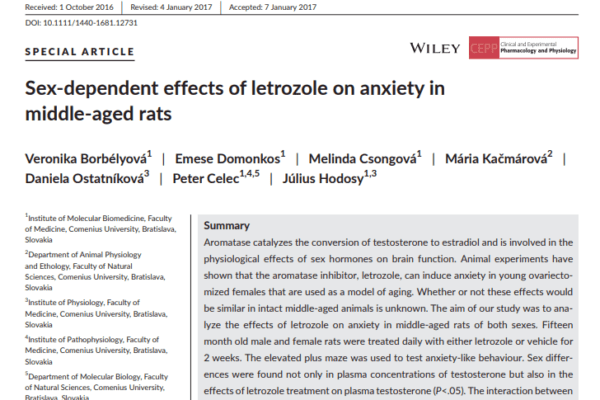
    Sex-dependent effects of letrozole on anxiety in middle-aged rats

    Sex-dependent effects of letrozole on anxiety in middle-aged rats

    AUTORI: Borbelyova, V., E. Renczes Domonkos, M. Csongova, M. Kacmarova, D. Ostatnikova, P. Celec, and J. Hodosy

    ABSTRACT: Aromatase catalyzes the conversion of testosterone to estradiol and is involved in the physiological effects of sex hormones on brain function. Animal experiments have shown that the aromatase inhibitor, letrozole, can induce anxiety in young ovariectomized females that are used as a model of aging. Whether or not these effects would be similar in intact middle-aged animals is unknown. The aim of our study was to analyze the effects of letrozole on anxiety in middle-aged rats of both sexes. Fifteen month old male and female rats were treated daily with either letrozole or vehicle for 2 weeks. The elevated plus maze was used to test anxiety-like behaviour. Sex differences were found not only in plasma concentrations of testosterone but also in the effects of letrozole treatment on plasma testosterone (P<.05). The interaction between sex and treatment was also proven in locomotor activity (P<.05) and time spent in the open arms of the elevated plus maze (P<.05). Letrozole-treated male rats spent 95% less time in the open arms of the elevated plus maze than the control rats did (P<.05) suggesting an anxiogenic effect of aromatase inhibition. This difference was not found between letrozole-treated and vehicle-treated females. In contrast to previous experiments on young animals, letrozole seems to induce anxiety in male but not in female middle-aged rats. This sex-specific effect might be related to sex differences of oestrogen and androgen signalling in aging brains. These results should be taken into account in clinical applications of letrozole, especially in men.

    Clin Exp Pharmacol Physiol, 2017. 44 Suppl 1: p. 93-98.

    https://onlinelibrary.wiley.com/doi/full/10.1111/1440-1681.12731

    • 1. JUNE 2017
    Fecal calprotectin levels correlate with main domains of the autism diagnostic interview-revised (ADI-R) in a sample of individuals with autism spectrum disorders from Slovakia

    Fecal calprotectin levels correlate with main domains of the autism diagnostic interview-revised (ADI-R) in a sample of individuals with autism spectrum disorders from Slovakia

    AUTORI: Babinska, K., Tomova, A., Celusakova, H., Babkova, J., Repiska, G., Kubranska, A., Filcikova, D., Siklenkova, L., and Ostatnikova, D.

    ABSTRACT: Autism spectrum disorders (ASD) are neurodevelopmental disorders characterized by impaired social interaction and communication, as well as repetitive behavior and restricted interests. There is convincing evidence that the intestinal inflammation is involved in etiology of ASD. Increased levels of inflammatory markers were shown to be associated with more aberrant behaviors and communication of subjects with ASD. Calprotectin in the feces is produced by activated neutrophils and epithelial cells of the gut mucosa, and its levels reflect local inflammation of the gastrointestinal tract. Concentration of fecal calprotectin was determined by ELISA method in 87 individuals with ASD and 51 controls, of that 29 siblings of children with ASD and 22 non-related controls. In non-relatives significantly lower values of fecal calprotectin were observed than in both subjects with ASD and their siblings. In the group with ASD significant correlations of fecal calprotectin with all domains of the ADI-R diagnostic tool were found: qualitative abnormalities in reciprocal social interaction and communication, restrictive and repetitive patterns of behavior. Results suggest that low grade intestinal inflammation may be one of factors implicated in the pathophysiology of ASD.

    Physiol Res, 2017. 66(Supplementum 4): p. S517-S522.

    http://www.biomed.cas.cz/physiolres/pdf/66/66_S517.pdf

    • 1. MAY 2017
    Screening for autism spectrum disorders inpopulation of young children in Slovakia

    Screening for autism spectrum disorders inpopulation of young children in Slovakia

    AUTORI: Hnilicová, S., Celušáková, H., Hnilica, P., Babinská, K., Pivovarčiová, A., Ostatníková, D.

    ABSTRACT: OBJECTIVES: The aim of our study was to assess efficacy of using M-CHAT R/F questionnaire for screening for Autism Spectrum Disorders (ASD) in a sample of Slovak population and compare it with objective diagnostic ASD tool ADI-R. M-CHAT R/T comparison with ADOS-2 diagnostic tool will be published and discussed elsewhere.
    METHODS: 92 children with ASD, 72 boys (91.2%), and 20 girls (8.9%), age 1.0–6.9 years, who were signed up by their parents for ASD testing at our institution from 2013 to 2016 were enrolled. All participants were screened by M-CHAT questionnaire filled out by a parent and then complex psychological assessment by trained staff was performed. Latter evaluation included ASD diagnostic tools: Autism Diagnostic Observation Schedule – second revision (ADOS-2) and Autism Diagnostic Interview-Revised (ADI-R).
    RESULTS: Significant difference of total (sum) score of M-CHAT means between group of children with ASD and without ASD (as diagnosed by using ADOS and ADI-R) was observed (p<0.001). M-CHAT total score significantly correlated with ADI-R A Domain Abnormalities in Reciprocal Social Interaction, (r=0.583; p<0.01); ADI-R B Domain – Qualitative Abnormalities in Communication (r=0.357; p<0.01).
    CONCLUSION: We demonstrated that in our sample of Slovak children M-CHAT total score can be used to differentiate between children with and without ASD risk. M-CHAT also well correlated with accepted objective measure for diagnosis of ASD, i.e. ADI-R. Future work is needed to determine the sensitivity and specificity of M-CHAT in screening for ASD in general population of children in Slovakia.

    Activitas Nervosa Superior Rediviva. – Vol. 59, No. 1 (2017), s. 29-32. – ISSN (print) 1337-933X

    http://www.rediviva.sav.sk/59i1/29.pdf