• 1. JUNE 2018
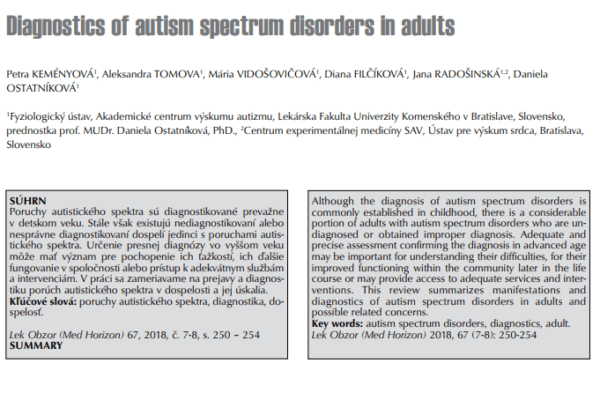
    Diagnostika porúch autistického spektra v dospelosti (Diagnostics of autism spectrum disorders in adults)

    Diagnostika porúch autistického spektra v dospelosti (Diagnostics of autism spectrum disorders in adults)

    AUTORI: Keményová, P., Sashova Tomova, A., Vidošovičová, M., Čelárová, D., Radošinská, J., Ostatníková, D.

    ABSTRACT: Although the diagnosis of autism spectrum disorders is commonly established in childhood, there is a considerable portion of adults with autism spectrum disorders who are undiagnosed or obtained improper diagnosis. Adequate and precise assessment confirming the diagnosis in advanced age may be important for understanding their difficulties, for their improved functioning within the community later in the life course or may provide access to adequate services and interventions. This review summarizes manifestations and diagnostics of autism spectrum disorders in adults and possible related concerns.

    Lekársky obzor. – Roč. 67, č. 7-8 (2018), s. 250-254. – ISSN (print) 0457-4214
    Lekársky obzor – HERBA – Lekársky obzor 7-8/2018

    • 1. JUNE 2018
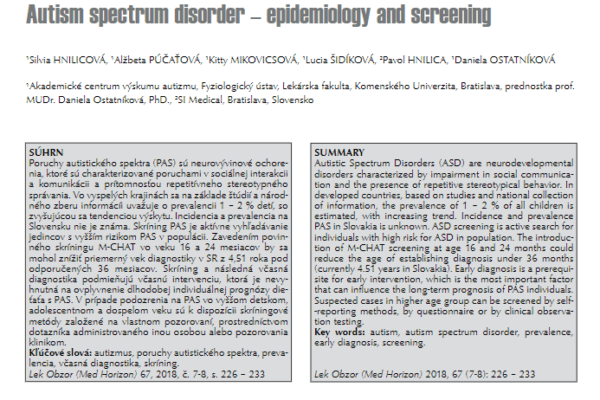
    Poruchy autistického spektra – epidemiológia a skríning (Autism spectrum disorder – epidemiology and screening)

    Poruchy autistického spektra – epidemiológia a skríning (Autism spectrum disorder – epidemiology and screening)

    AUTORI: Hnilicová, S., Púčaťová, A., Mikovicsová, K., Šidíková, L., Hnilica, P., Ostatníková, D.

    ABSTRACT: Autistic Spectrum Disorders (ASD) are neurodevelopmental disorders characterized by impairment in social communication and the presence of repetitive stereotypical behavior. In developed countries, based on studies and national collection of information, the prevalence of 1 – 2 % of all children is estimated, with increasing trend. Incidence and prevalence ASD in Slovakia is unknown. ASD screening is active search for individuals with high risk for ASD in population. The introduction of M-CHAT screening at age 16 and 24 months could reduce the age of establishing diagnosis under 36 months (currently 4.51 years in Slovakia). Early diagnosis is a prerequisite for early intervention, which is the most important factor that can influence the long-term prognosis of PAS individuals. Suspected cases in higher age group can be screened by self-reporting methods, by questionnaire or by clinical observation testing.

    Lekársky obzor. – Roč. 67, č. 7-8 (2018), s. 226-233. – ISSN (print) 0457-4214

    Lekársky obzor – HERBA – Lekársky obzor 7-8/2018

    • 1. JUNE 2018
    Na dôkazoch založené intervencie pre ľudí s poruchou autistického spektra (Evidence-based interventions for individuals with autism spectrum disorders)

    Na dôkazoch založené intervencie pre ľudí s poruchou autistického spektra (Evidence-based interventions for individuals with autism spectrum disorders)

    AUTORI: Čelárová, D., Celušáková, H., Trellová, I., Szapuová, Ž., Ostatníková, D.

    ABSTRACT: Autism spectrum disorders are a group of neurodevelopmental disorders that manifest in early childhood and persist throughout the lifespan. Core symptoms include social communication deficits and the presence of stereotyped and repetitive behaviors. Despite intensive research, the etiology still remains unknown, and no medications are approved for the treatment of core symptoms of autism. Evidence-based interventions are based on the principles of applied behavioral analysis, and has been shown to be effective particularly when used in early childhod. Parents of children with autism spectrum disorder, however, often invest their finance and time into interventions that are not only ineffective, but can also pose a threat to the healthy development of the child. The role of professionals should therefore be to help parents to be able to decide for the most effective treatment for their child and by that increase the quality of life for the whole family.

    Lekársky obzor. – Roč. 67, č. 7-8 (2018), s. 255-259. – ISSN (print) 0457-4214

    Lekársky obzor – HERBA – Lekársky obzor 7-8/2018

    • 1. JUNE 2018
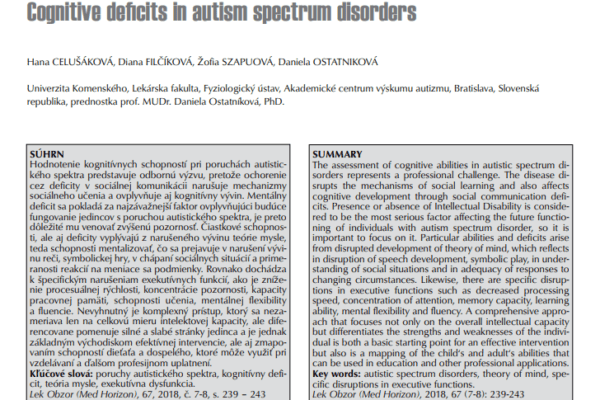
    Kognitívne deficity pri poruchách autistického spektra (Cognitive deficits in autism spectrum disorders)

    Kognitívne deficity pri poruchách autistického spektra (Cognitive deficits in autism spectrum disorders)

    AUTORI: Celušáková, H., Čelárová, D., Szapuová, Ž., Ostatníková, D.

    ABSTRACT: The assessment of cognitive abilities in autistic spectrum disorders represents a professional challenge. The disease disrupts the mechanisms of social learning and also affects cognitive development through social communication deficits. Presence or absence of Intellectual Disability is considered to be the most serious factor affecting the future functioning of individuals with autism spectrum disorder, so it is important to focus on it. Particular abilities and deficits arise from disrupted development of theory of mind, which reflects in disruption of speech development, symbolic play, in understanding of social situations and in adequacy of responses to changing circumstances. Likewise, there are specific disruptions in executive functions such as decreased processing speed, concentration of attention, memory capacity, learning ability, mental flexibility and fluency. A comprehensive approach that focuses not only on the overall intellectual capacity but differentiates the strengths and weaknesses of the individual is both a basic starting point for an effective intervention but also is a mapping of the child‘s and adult‘s abilities that can be used in education and other professional applications.

    Lekársky obzor. – Roč. 67, č. 7-8 (2018), s. 239-243. – ISSN (print) 0457-4214

    Lekársky obzor – HERBA – Lekársky obzor 7-8/2018