
• 1. JUNE 2018
    • 0
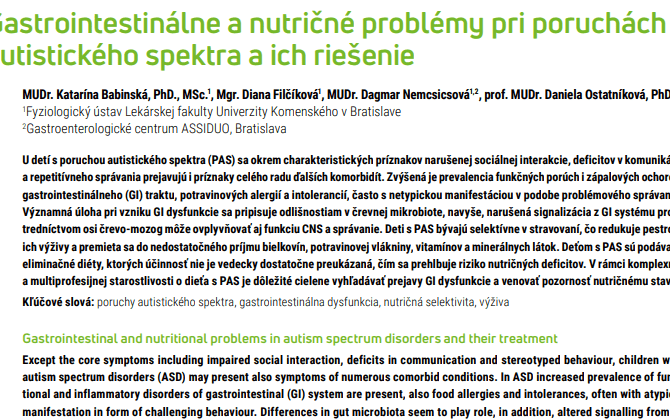
    Nutričné a gastrointestinálne problémy pri poruchách autistického spektra a ich riešenie (Gastrointestinal and nutritional problems in autism spectrum disorders and their treatment)

    Nutričné a gastrointestinálne problémy pri poruchách autistického spektra a ich riešenie (Gastrointestinal and nutritional problems in autism spectrum disorders and their treatment)

    AUTORI: Babinská, K., Filčíková, D., Nemcsicsová, D., Ostatníková, D.

    ABSTRACT: Except the core symptoms including impaired social interaction, deficits in communication and stereotyped behaviour, children with autism spectrum disorders (ASD) may present also symptoms of numerous comorbid conditions. In ASD increased prevalence of functional and inflammatory disorders of gastrointestinal (GI) system are present, also food allergies and intolerances, often with atypical manifestation in form of challenging behaviour. Differences in gut microbiota seem to play role, in addition, altered signalling from GI system via the gut-brain axis may affect the function of the CNS and behaviour. Children with ASD display food selectivity with adverse consequences on food variety and subsequent inadequate intake of protein, dietary fibre, vitamins, and minerals. Without professional counselling, children with ASD are often exposed to elimination diets. Their effectiveness is not sufficiently supported by scientific data, and they put the child even at more increased risk of nutritional deficiency. Complex and multiprofessional care about a child with ASD should include targeted search for symptoms of GI dysfunction and examination of nutritional status.

    Pediatria pre prax. – Roč. 19, č. 2 (2018), s. 57-60. – ISSN (print) 1336-8168

    Read more
    • 1. MAY 2018
    • 0
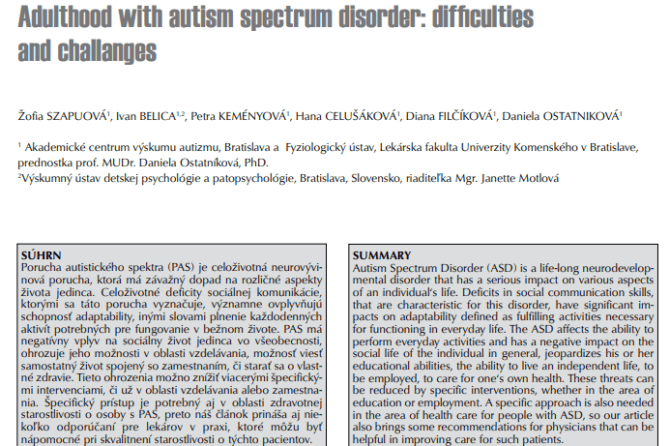
    Adulthood with autism spectrum disorder: difficulties and challenges (Život s poruchou autistického spektra v dospelosti: problémy a výzvy)

    Adulthood with autism spectrum disorder: difficulties and challenges (Život s poruchou autistického spektra v dospelosti: problémy a výzvy)

    AUTHORS: Szapuová, Ž., Belica, I., Keményová, P., Celušáková, H., Čelárová, D., Ostatníková, D.

    ABSTRACT: Autism Spectrum Disorder (ASD) is a life-long neurodevelopmental disorder that has a serious impact on various aspects of an individual‘s life. Deficits in social communication skills, that are characteristic for this disorder, have significant impacts on adaptability defined as fulfilling activities necessary for functioning in everyday life. The ASD affects the ability to perform everyday activities and has a negative impact on the social life of the individual in general, jeopardizes his or her educational abilities, the ability to live an independent life, to be employed, to care for one‘s own health. These threats can be reduced by specific interventions, whether in the area of education or employment. A specific approach is also needed in the area of health care for people with ASD, so our article also brings some recommendations for physicians that can be helpful in improving care for such patients.

    Lekársky obzor. – Roč. 67, č. 7-8 (2018), s. 260-265. – ISSN (print) 0457-4214

    Lekársky obzor – HERBA – Lekársky obzor 7-8/2018

    Read more
    • 1. MAY 2018
    • 0
    Život sporuchou autistického spektra v dospelosti: problémy a výzvy (Adulthood with autism spectrum disorder: difficulties and challenges)

    Život sporuchou autistického spektra v dospelosti: problémy a výzvy (Adulthood with autism spectrum disorder: difficulties and challenges)

    AUTORI: Szapuová, Ž., Belica, I., Keményová, P., Celušáková, H., Čelárová, D., Ostatníková, D.

    ABSTRACT: Autism Spectrum Disorder (ASD) is a life-long neurodevelopmental disorder that has a serious impact on various aspects of an individual‘s life. Deficits in social communication skills, that are characteristic for this disorder, have significant impacts on adaptability defined as fulfilling activities necessary for functioning in everyday life. The ASD affects the ability to perform everyday activities and has a negative impact on the social life of the individual in general, jeopardizes his or her educational abilities, the ability to live an independent life, to be employed, to care for one‘s own health. These threats can be reduced by specific interventions, whether in the area of education or employment. A specific approach is also needed in the area of health care for people with ASD, so our article also brings some recommendations for physicians that can be helpful in improving care for such patients.

    Lekársky obzor. – Roč. 67, č. 7-8 (2018), s. 260-265. – ISSN (print) 0457-4214

    Lekársky obzor – HERBA – Lekársky obzor 7-8/2018

    Read more
    • 1. APRIL 2018
    • 0
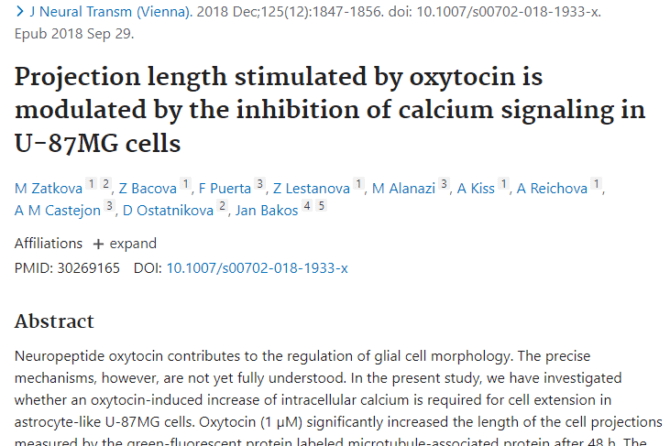
    Projection length stimulated by oxytocin is modulated by the inhibition of calcium signaling in U-87MG cells

    Projection length stimulated by oxytocin is modulated by the inhibition of calcium signaling in U-87MG cells

    AUTHORS: Zatkova, M., Z. Bacova, F. Puerta, Z. Lestanova, M. Alanazi, A. Kiss, A. Reichova, A.M. Castejon, D. Ostatnikova, and J. Bakos

    ABSTRACT: Neuropeptide oxytocin contributes to the regulation of glial cell morphology. The precise mechanisms, however, are not yet fully understood. In the present study, we have investigated whether an oxytocin-induced increase of intracellular calcium is required for cell extension in astrocyte-like U-87MG cells. Oxytocin (1 µM) significantly increased the length of the cell projections measured by the green-fluorescent protein labeled microtubule-associated protein after 48 h. The knockdown of oxytocin receptors (OXTR) in U-87MG cells prevented the elongation of the projections. Incubation of U-87MG cells in the presence of oxytocin, resulted in a significant increase of intracellular calcium, specifically blocked by the OXTR antagonist L-371,257. Both quercetin, which is a phosphoinositide 3-kinase inhibitor, and the phospholipase C inhibitor U-73122 reduced oxytocin-induced elevation of intracellular calcium concentration. Conversely, neither diltiazem, an L-type voltage-gated calcium channel blocker nor tetracaine, which is a blocker of the ryanodine receptors, showed an effect on intracellular calcium levels. Treatment of cells with quercetin, U-73122 and the voltage-gated calcium channel blockers cilnidipine, ω-agatoxin and mibefradil prevented the elongation of projections stimulated by oxytocin. Oxytocin treatment resulted in a significant increase in gene and protein expression of the scaffolding protein SHANK3. Our results clearly show that activation of OXTRs contributes to the elongation of cell projections in astrocyte-like U-87MG cells and that this effect is mediated by an extracellular calcium influx accompanied by an increase in scaffolding proteins expression.

    J Neural Transm (Vienna), 2018. 125(12): p. 1847-1856.

    https://pubmed.ncbi.nlm.nih.gov/30269165/

    Read more

Photostream