• 10. JANUARY 2020
    • 0
    Rozhovor v týždenníku TÉMA s profesorkou MUDr. Danielou Ostatníkovou, PhD, “Nie všetci sú géniovia“

    Rozhovor v týždenníku TÉMA s profesorkou MUDr. Danielou Ostatníkovou, PhD, “Nie všetci sú géniovia“

    V rozhovore nájdete informácie o včasnej diagnostika detí s autizmom, o Akademickom centre výskumu autizmu, ako aj mnohé ďalšie odpovede na otázky, ktoré sa dotýkajú autizmu.

    Zdroj týždenník TÉMA 22_ 2019


    Read more
    • 1. AUGUST 2019
    • 0
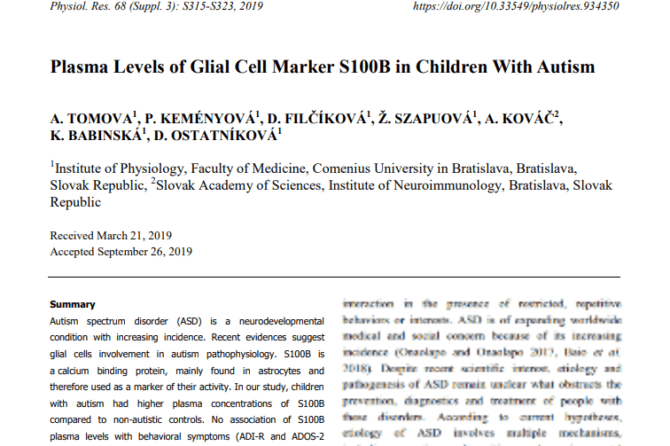
    Plasma levels of glial cell marker S100B in children with autism

    Plasma levels of glial cell marker S100B in children with autism

    AUTHORS: Sashova Tomova, A., Kemenyova, P., Celarova, D., Szapuova, Z., Kovac, A., Babinska, K., Ostatnikova D.

    ABSTRACT: Autism spectrum disorder (ASD) is a neurodevelopmental condition with increasing incidence. Recent evidences suggest glial cells involvement in autism pathophysiology. S100B is a calcium binding protein, mainly found in astrocytes and therefore used as a marker of their activity. In our study, children with autism had higher plasma concentrations of S100B compared to non-autistic controls. No association of S100B plasma levels with behavioral symptoms (ADI-R and ADOS-2 scales) was found. Plasma S100B concentration significantly correlated with urine serotonin, suggesting their interconnection. Correlation of plasma S100B levels with stool calprotectin concentrations was found, suggesting not only brain astrocytes, but also enteric glial cells may take part in autism pathogenesis. Based on our findings, S100B seems to have a potential to be used as a biomarker of human neurodevelopmental disorders, but more investigations are needed to clarify its exact role in pathomechanism of autism.

    Physiol Res, 2019. 68(3) Supplementum: 315-323.

    http://www.biomed.cas.cz/physiolres/pdf/68/68_S315.pdf

    Read more

    • 1. AUGUST 2019
    • 0
    Plasma levels of glial cell marker S100B in children with autism

    Plasma levels of glial cell marker S100B in children with autism

    AUTORI: Sashova Tomova, A., Kemenyova, P., Celarova, D., Szapuova, Z., Kovac, A., Babinska, K., Ostatnikova D.

    ABSTRACT: Autism spectrum disorder (ASD) is a neurodevelopmental condition with increasing incidence. Recent evidences suggest glial cells involvement in autism pathophysiology. S100B is a calcium binding protein, mainly found in astrocytes and therefore used as a marker of their activity. In our study, children with autism had higher plasma concentrations of S100B compared to non-autistic controls. No association of S100B plasma levels with behavioral symptoms (ADI-R and ADOS-2 scales) was found. Plasma S100B concentration significantly correlated with urine serotonin, suggesting their interconnection. Correlation of plasma S100B levels with stool calprotectin concentrations was found, suggesting not only brain astrocytes, but also enteric glial cells may take part in autism pathogenesis. Based on our findings, S100B seems to have a potential to be used as a biomarker of human neurodevelopmental disorders, but more investigations are needed to clarify its exact role in pathomechanism of autism.

    Physiol Res, 2019. 68(3) Supplementum: 315-323.

    http://www.biomed.cas.cz/physiolres/pdf/68/68_S315.pdf

    Read more

    • 1. JULY 2019
    • 0
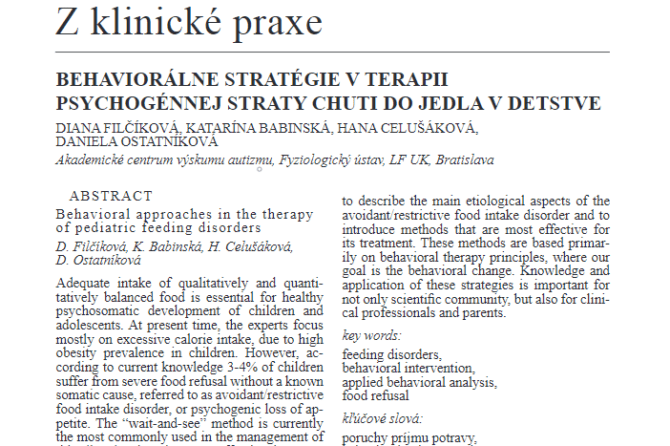
    Behavioral approaches in the therapy of pediatric feeding disorders (Behaviorálne stratégie v terapii psychogénnej straty chuti do jedla v detstve)

    Behavioral approaches in the therapy of pediatric feeding disorders (Behaviorálne stratégie v terapii psychogénnej straty chuti do jedla v detstve)

    AUTHORS: Celarova, D., Babinska, K., Celusakova, H., Ostatnikova, D.

    ABSTRACT: Adequate intake of qualitatively and quantitatively balanced food is essential for healthy psychosomatic development of children and adolescents. At present time, the experts focus mostly on excessive calorie intake, due to high obesity prevalence in children. However, according to current knowledge 3-4% of children suffer from severe food refusal without a known somatic cause, referred to as avoidant/restrictive food intake disorder, or psychogenic loss of appetite. The “wait-and-see” method is currently the most commonly used in the management of this disorder, but the most effective intervention has been shown to be techniques based on behavioral therapy. The aim of our work is to describe the main etiological aspects of the avoidant/restrictive food intake disorder and to introduce methods that are most effective for its treatment. These methods are based primarily on behavioral therapy principles, where our goal is the behavioral change. Knowledge and application of these strategies is important for not only scientific community, but also for clinical professionals and parents.

    Československá psychologie 2019. 63(1): p. 116-126.

    https://kramerius.lib.cas.cz/view/uuid:3db71ce2-5b9a-4a18-b704-655c14576081?article=uuid:dc4dfdb2-e3a4-4c90-818d-42435fe5abe5

    Read more

Photostream