• 1. AUGUST 2019
    Plasma levels of glial cell marker S100B in children with autism

    Plasma levels of glial cell marker S100B in children with autism

    AUTHORS: Sashova Tomova, A., Kemenyova, P., Celarova, D., Szapuova, Z., Kovac, A., Babinska, K., Ostatnikova D.

    ABSTRACT: Autism spectrum disorder (ASD) is a neurodevelopmental condition with increasing incidence. Recent evidences suggest glial cells involvement in autism pathophysiology. S100B is a calcium binding protein, mainly found in astrocytes and therefore used as a marker of their activity. In our study, children with autism had higher plasma concentrations of S100B compared to non-autistic controls. No association of S100B plasma levels with behavioral symptoms (ADI-R and ADOS-2 scales) was found. Plasma S100B concentration significantly correlated with urine serotonin, suggesting their interconnection. Correlation of plasma S100B levels with stool calprotectin concentrations was found, suggesting not only brain astrocytes, but also enteric glial cells may take part in autism pathogenesis. Based on our findings, S100B seems to have a potential to be used as a biomarker of human neurodevelopmental disorders, but more investigations are needed to clarify its exact role in pathomechanism of autism.

    Physiol Res, 2019. 68(3) Supplementum: 315-323.

    http://www.biomed.cas.cz/physiolres/pdf/68/68_S315.pdf

    • 1. JULY 2019
    Behavioral approaches in the therapy of pediatric feeding disorders (Behaviorálne stratégie v terapii psychogénnej straty chuti do jedla v detstve)

    Behavioral approaches in the therapy of pediatric feeding disorders (Behaviorálne stratégie v terapii psychogénnej straty chuti do jedla v detstve)

    AUTHORS: Celarova, D., Babinska, K., Celusakova, H., Ostatnikova, D.

    ABSTRACT: Adequate intake of qualitatively and quantitatively balanced food is essential for healthy psychosomatic development of children and adolescents. At present time, the experts focus mostly on excessive calorie intake, due to high obesity prevalence in children. However, according to current knowledge 3-4% of children suffer from severe food refusal without a known somatic cause, referred to as avoidant/restrictive food intake disorder, or psychogenic loss of appetite. The “wait-and-see” method is currently the most commonly used in the management of this disorder, but the most effective intervention has been shown to be techniques based on behavioral therapy. The aim of our work is to describe the main etiological aspects of the avoidant/restrictive food intake disorder and to introduce methods that are most effective for its treatment. These methods are based primarily on behavioral therapy principles, where our goal is the behavioral change. Knowledge and application of these strategies is important for not only scientific community, but also for clinical professionals and parents.

    Československá psychologie 2019. 63(1): p. 116-126.

    https://kramerius.lib.cas.cz/view/uuid:3db71ce2-5b9a-4a18-b704-655c14576081?article=uuid:dc4dfdb2-e3a4-4c90-818d-42435fe5abe5

    • 1. JUNE 2019
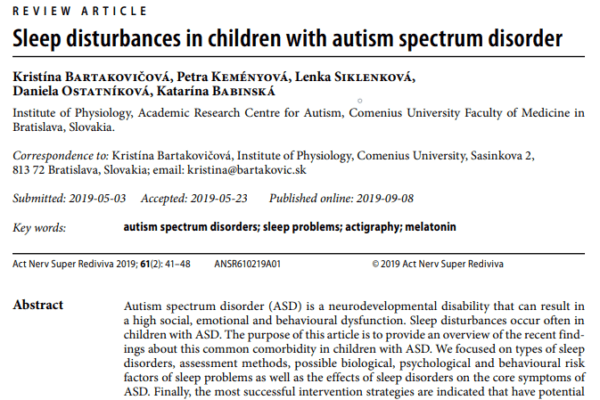
    Sleep disturbances in children with autism spectrum disorder

    Sleep disturbances in children with autism spectrum disorder

    AUTHORS: Bartakovičová, K., Keményová, P., Siklenková, L., Ostatníková, D., Babinská, K..

    ABSTRACT: Autism spectrum disorder (ASD) is a neurodevelopmental disability that can result in a high social, emotional and behavioural dysfunction. Sleep disturbances occur often in children with ASD. The purpose of this article is to provide an overview of the recent findings about this common comorbidity in children with ASD. We focused on types of sleep disorders, assessment methods, possible biological, psychological and behavioural risk factors of sleep problems as well as the effects of sleep disorders on the core symptoms of ASD. Finally, the most successful intervention strategies are indicated that have potential to improve the quality of life of children with ASD and their families.

    Activitas Nervosa Superior Rediviva. – Roč. 61, č. 2 (2019), s. 41-48. – ISSN (print) 1337-933X

    http://rediviva.sav.sk/61i2/41.pdf

    • 1. JUNE 2019
    Erythrocyte deformability in children with autism spectrum disorders: correlation with clinical features

    Erythrocyte deformability in children with autism spectrum disorders: correlation with clinical features

    AUTHORS: Jasenovec, T., Radosinska, D., Celusakova, H., Celarova, D., Radosinska, J.

    ABSTRACT: Biomechanical properties of erythrocytes play an important role in health and disease. Deformability represents intrinsic property of erythrocytes to undergo deformation that is crucial for their passage through the narrow capillaries. The erythrocyte damage can lead to compromised tissue perfusion and consequently play a role in the pathogenesis of various diseases including neurological ones. Data available in databases indicate that erythrocytes in autism spectrum disorder (ASD) are altered. This may affect the clinical symptoms of ASD. The aim of our study was to determine erythrocyte deformability in 54 children with ASD and correlate it with clinical symptoms. We found significant negative correlation between erythrocyte deformability and score in C domain of the Autism Diagnostic Interview Revised (ADI-R) diagnostic tool describing the measure of restrictive, repetitive, and stereotyped behaviors and interests, mainly observable in C1 and C2, but not in C3 and C4 subdomains. This supports the findings of other authors and suggest that behavioral domain C comprises of more subcategories with different underlying etiology. Our results also indicate that abnormalities in erythrocyte deformability may be involved in ASD pathomechanisms and contribute to its clinical manifestation. Further research is necessary to bring more data and identify erythrocyte deformability as prognostic biomarker in ASD.

    Physiol Res, 2019. 68(3) Supplementum: 307-313.

    http://www.biomed.cas.cz/physiolres/pdf/68/68_S307.pdf