
• 1. JUNE 2017
    • 0
    Fecal calprotectin levels correlate with main domains of the autism diagnostic interview-revised (ADI-R) in a sample of individuals with autism spectrum disorders from Slovakia

    Fecal calprotectin levels correlate with main domains of the autism diagnostic interview-revised (ADI-R) in a sample of individuals with autism spectrum disorders from Slovakia

    AUTORI: Babinska, K., Tomova, A., Celusakova, H., Babkova, J., Repiska, G., Kubranska, A., Filcikova, D., Siklenkova, L., and Ostatnikova, D.

    ABSTRACT: Autism spectrum disorders (ASD) are neurodevelopmental disorders characterized by impaired social interaction and communication, as well as repetitive behavior and restricted interests. There is convincing evidence that the intestinal inflammation is involved in etiology of ASD. Increased levels of inflammatory markers were shown to be associated with more aberrant behaviors and communication of subjects with ASD. Calprotectin in the feces is produced by activated neutrophils and epithelial cells of the gut mucosa, and its levels reflect local inflammation of the gastrointestinal tract. Concentration of fecal calprotectin was determined by ELISA method in 87 individuals with ASD and 51 controls, of that 29 siblings of children with ASD and 22 non-related controls. In non-relatives significantly lower values of fecal calprotectin were observed than in both subjects with ASD and their siblings. In the group with ASD significant correlations of fecal calprotectin with all domains of the ADI-R diagnostic tool were found: qualitative abnormalities in reciprocal social interaction and communication, restrictive and repetitive patterns of behavior. Results suggest that low grade intestinal inflammation may be one of factors implicated in the pathophysiology of ASD.

    Physiol Res, 2017. 66(Supplementum 4): p. S517-S522.

    http://www.biomed.cas.cz/physiolres/pdf/66/66_S517.pdf

    Read more
    • 1. MAY 2017
    • 0
    Screening for autism spectrum disorders inpopulation of young children in Slovakia

    Screening for autism spectrum disorders inpopulation of young children in Slovakia

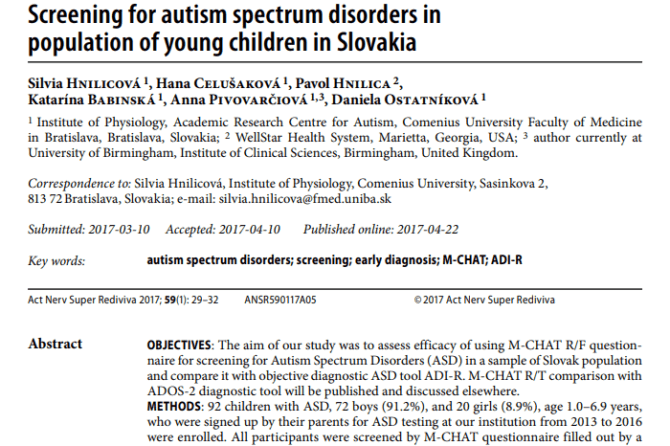
    AUTHORS: Hnilicová, S., Celušáková, H., Hnilica, P., Babinská, K., Pivovarčiová, A., Ostatníková, D.

    ABSTRACT: OBJECTIVES: The aim of our study was to assess efficacy of using M-CHAT R/F questionnaire for screening for Autism Spectrum Disorders (ASD) in a sample of Slovak population and compare it with objective diagnostic ASD tool ADI-R. M-CHAT R/T comparison with ADOS-2 diagnostic tool will be published and discussed elsewhere.
    METHODS: 92 children with ASD, 72 boys (91.2%), and 20 girls (8.9%), age 1.0–6.9 years, who were signed up by their parents for ASD testing at our institution from 2013 to 2016 were enrolled. All participants were screened by M-CHAT questionnaire filled out by a parent and then complex psychological assessment by trained staff was performed. Latter evaluation included ASD diagnostic tools: Autism Diagnostic Observation Schedule – second revision (ADOS-2) and Autism Diagnostic Interview-Revised (ADI-R).
    RESULTS: Significant difference of total (sum) score of M-CHAT means between group of children with ASD and without ASD (as diagnosed by using ADOS and ADI-R) was observed (p<0.001). M-CHAT total score significantly correlated with ADI-R A Domain Abnormalities in Reciprocal Social Interaction, (r=0.583; p<0.01); ADI-R B Domain – Qualitative Abnormalities in Communication (r=0.357; p<0.01).
    CONCLUSION: We demonstrated that in our sample of Slovak children M-CHAT total score can be used to differentiate between children with and without ASD risk. M-CHAT also well correlated with accepted objective measure for diagnosis of ASD, i.e. ADI-R. Future work is needed to determine the sensitivity and specificity of M-CHAT in screening for ASD in general population of children in Slovakia.

    Activitas Nervosa Superior Rediviva. – Vol. 59, No. 1 (2017), s. 29-32. – ISSN (print) 1337-933X

    http://www.rediviva.sav.sk/59i1/29.pdf

    Read more
    • 1. MAY 2017
    • 0
    Screening for autism spectrum disorders inpopulation of young children in Slovakia

    Screening for autism spectrum disorders inpopulation of young children in Slovakia

    AUTORI: Hnilicová, S., Celušáková, H., Hnilica, P., Babinská, K., Pivovarčiová, A., Ostatníková, D.

    ABSTRACT: OBJECTIVES: The aim of our study was to assess efficacy of using M-CHAT R/F questionnaire for screening for Autism Spectrum Disorders (ASD) in a sample of Slovak population and compare it with objective diagnostic ASD tool ADI-R. M-CHAT R/T comparison with ADOS-2 diagnostic tool will be published and discussed elsewhere.
    METHODS: 92 children with ASD, 72 boys (91.2%), and 20 girls (8.9%), age 1.0–6.9 years, who were signed up by their parents for ASD testing at our institution from 2013 to 2016 were enrolled. All participants were screened by M-CHAT questionnaire filled out by a parent and then complex psychological assessment by trained staff was performed. Latter evaluation included ASD diagnostic tools: Autism Diagnostic Observation Schedule – second revision (ADOS-2) and Autism Diagnostic Interview-Revised (ADI-R).
    RESULTS: Significant difference of total (sum) score of M-CHAT means between group of children with ASD and without ASD (as diagnosed by using ADOS and ADI-R) was observed (p<0.001). M-CHAT total score significantly correlated with ADI-R A Domain Abnormalities in Reciprocal Social Interaction, (r=0.583; p<0.01); ADI-R B Domain – Qualitative Abnormalities in Communication (r=0.357; p<0.01).
    CONCLUSION: We demonstrated that in our sample of Slovak children M-CHAT total score can be used to differentiate between children with and without ASD risk. M-CHAT also well correlated with accepted objective measure for diagnosis of ASD, i.e. ADI-R. Future work is needed to determine the sensitivity and specificity of M-CHAT in screening for ASD in general population of children in Slovakia.

    Activitas Nervosa Superior Rediviva. – Vol. 59, No. 1 (2017), s. 29-32. – ISSN (print) 1337-933X

    http://www.rediviva.sav.sk/59i1/29.pdf

    Read more
    • 1. MARCH 2017
    • 0
    What is the evidence of mitochondrial dysfunction in autism spectrum disorders?

    What is the evidence of mitochondrial dysfunction in autism spectrum disorders?

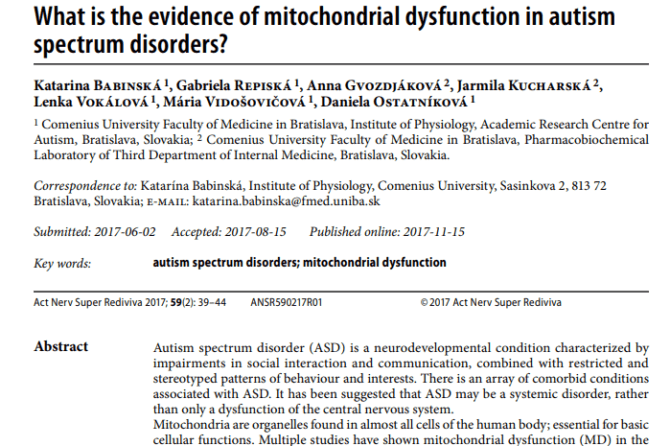
    AUTHORS: Babinská, K., Repiská, G., Gvozdjáková, A., Kucharská, J., Vokálová, L., Vidošovičová, M., Ostatníková,D.

    ABSTRACT: Autism spectrum disorder (ASD) is a neurodevelopmental condition characterized by impairments in social interaction and communication, combined with restricted and stereotyped patterns of behaviour and interests. There is an array of comorbid conditions associated with ASD. It has been suggested that ASD may be a systemic disorder, rather than only a dysfunction of the central nervous system. Mitochondria are organelles found in almost all cells of the human body; essential for basic cellular functions. Multiple studies have shown mitochondrial dysfunction (MD) in the brain, also in the peripheral tissues of individuals with ASD. It has been estimated that the prevalence of classic mitochondrial disease in ASD population is 5%; however, about 50% of children with ASD may present some abnormalities in markers of mitochondrial functions. Interactions between mitochondrial dysfunction and other underlying pathology of ASD were found, such as oxidative stress or immune dysregulation. Existing data indicate that mitochondrial dysfunction is implicated in pathology of ASD, at least in a subgroup of the patients. The evidence, however, is still only patchy. Advances in understanding of the involvement of mitochondrial dysfunction in ASD could be a step towards better understanding of the pathophysiology of ASD, and unravelling the role of mitochondria in ASD could open new prospectives for diagnostics and therapeutic interventions. There is a need to find a valid biomarker of mitochondrial dysfunction in ASD and to develop standardized procedures to identify the individuals with ASD and MD, who might mostly profit from an intervention.

    Activitas Nervosa Superior Rediviva. – Vol. 59, No. 2 (2017), s. 39-44. – ISSN (print) 1337-933X

    http://www.rediviva.sav.sk/59i2/39.pdf

    Read more

Photostream