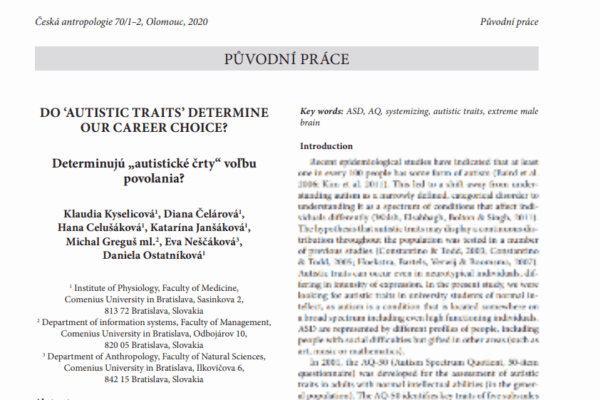
AUTORI: Kyselicová, K., Čelárová, D., Celušáková, H., Janšáková, K., Greguš, M., Neščáková, E., Ostatníková, D.
ABSTRACT: Objectives: Autistic traits may display a continuous distribution throughout the population. The aim of the present study was to assess the prevalence of autistic traits in university students and look for possible cognitive or behavioral differences between students of humanities and sciences in the context of the extreme male brain theory.
Participants and setting: The AQ-10 was used as a quick screening tool in a sample of 369 individuals enrolled in four programs: Medicine (N = 107), Psychology (N = 136), Biology (N = 89) and Management (N = 37).
Hypotheses: In accordance with the extreme male brain theory, we expected students of sciences to report more autistic traits than students of humanities, as well as males in general, when compared to females.
Statistical analysis: For the statistical analysis, GraphPad PRISM was used. To assess intersexual differences and differences between the study groups in the reached AQ-10 scores, a two way ANOVA was used.
Results: Sex differences in autistic traits and a relationship between autistic traits and area of study were found. Male students reached higher scores than females (p = 0.0016). Male psychology students reported less autistic traits than medicine students (p = 0.0413) or management students (p = 0.0292), while female psychology students reported less autistic traits than biology students (p = 0.0425). The AQ-10 tool was sensitive enough to capture differences in the occurrence of autistic traits between neurotypical students of humanities and scientific programs. Our findings raise the question whether ones admission to different programs and future career pathing is determined by traits that are associated with autism spectrum disorders.
Study limitations: There are certain limitations due to the high female: male ratio (267 : 102), caused by the current decrease of interest of males to study psychology and biology, where this ratio was notably uneven.
Česká antropologie, 2020, 70(1-2):4-10
http://anthropology.cz/wp-content/uploads/2021/02/CeskaAnthropo_2020_1-2-clanek1.pdf